By Selene Abellé for Expat Life Singapore
Living in Singapore has changed the way I understand tiredness.
Back home, fatigue often felt private, something carried behind closed doors. Here, it sometimes travels with you. It sits beside you on the bus after dinner, leans quietly against the window, taps its card at the reader, and says nothing.
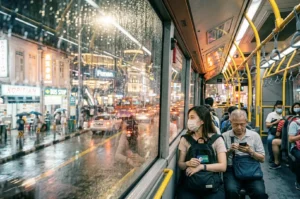
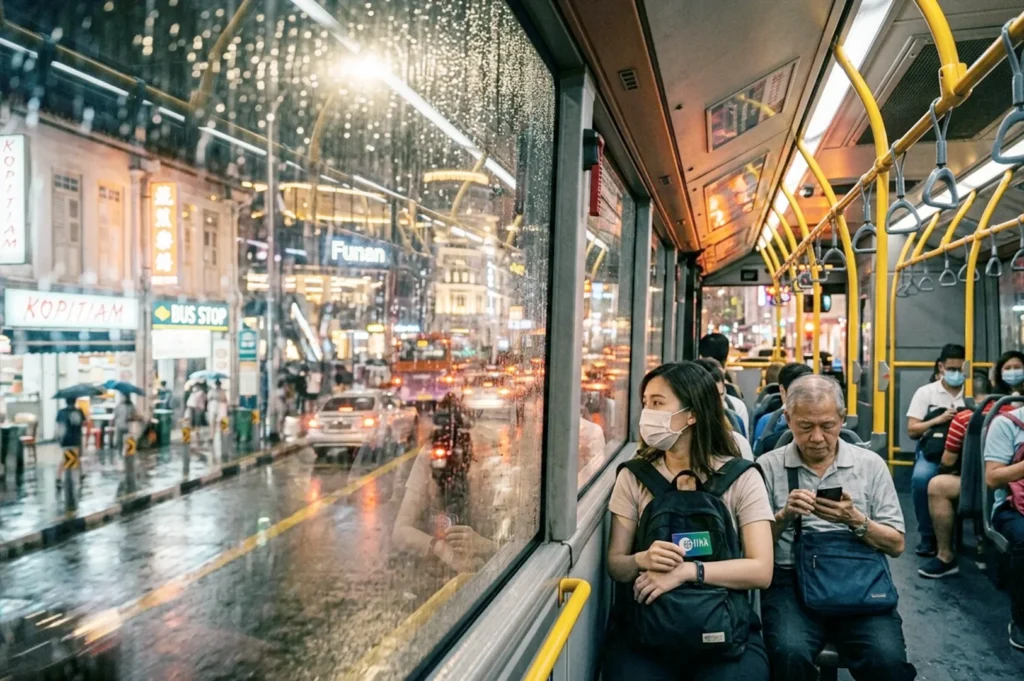
There is a particular kind of softness to the city after hours. Not silence exactly. Singapore rarely goes completely quiet. But the edges loosen. The office towers dim into reflections. The roads shine faintly after rain. The bus arrives with its interior lights glowing, and for a moment, it feels less like public transport and more like a small moving room for everyone who has given what they could to the day.
I remember one evening boarding a bus just after a sudden downpour.
The floor was damp near the entrance. Someone’s umbrella dripped steadily against a plastic shopping bag. A schoolboy sat with his head tilted against the glass, his uniform still neat but his eyes heavy. A woman in office shoes held a takeaway packet on her lap, the steam warming the thin plastic until the whole row smelled faintly of soy sauce, raincoats, and tired hands.
The air-conditioning was too cold at first, then comforting.
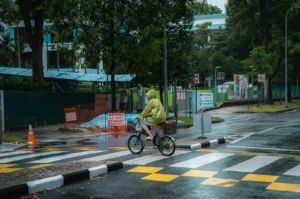
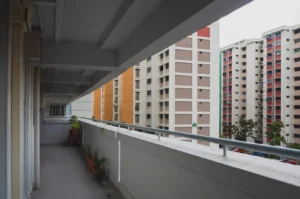
Outside, the city moved in fragments as we passed Toa Payoh. A wet pavement. A shuttered bakery. A cyclist waiting under a tree. HDB windows lit one by one, each square holding its own small evening: dinner, homework, television, someone rinsing a cup at the sink.
No one on the bus seemed eager to arrive, yet everyone was going somewhere.
That is what I have come to love about these late rides. They reveal a version of Singapore that is not trying to impress. Not efficient, not polished, not rushing toward the next achievement. Just alive in a quieter register.
The night bus teaches you that a city is not only made of destinations. It is made of the spaces between them, the pauses where people return to themselves.
There is intimacy in shared exhaustion. We do not speak, but we understand the posture of it: shoulders lowered, phones dimmed, bags held close, eyes fixed on nothing in particular.
Perhaps this is one way belonging begins. Not with arrival, but with recognition.
So the next time you take a Singapore bus line, don’t rush to fill the ride. Let the city pass slowly. Notice the smell of rain drying on sleeves, the soft beep of the fare reader, the way strangers make room without ceremony.
You may think you are simply going home.
But perhaps, quietly, Singapore is teaching you how to be held by a place.