
When my partner and I first navigated our own solemnisation in Singapore, I naively believed we were just signing a piece of paper. I imagined a quiet, administrative Tuesday morning, perhaps a quick coffee afterward, just the two of us, before returning to our respective laptops. But living in Singapore quickly teaches you that rituals are rarely just administrative.
As we clicked through the official government portals, a quiet avalanche of expectations began to build. Were our parents flying in? Where would we host the lunch? Had we prepared a red packet for the solemniser? What began as a “simple” legal registration gently evolved into a profoundly human, deeply cultural milestone. I’ve found that for expats and cross-cultural couples, the anxiety around getting married here rarely stems from the legal paperwork. Singapore’s digital systems are brilliantly efficient. The stress comes from not knowing which part is a legal requirement and which part is a quiet social expectation.
Did you Know? Chinese tea houses in Singapore are cherished venues for traditional tea ceremonies, an important part of many weddings symbolizing family unity. For expats, embracing such local customs offers a meaningful way to connect culture and embrace Expat Life Singapore.
Let’s circle back with the wonders of marriage in Singapore. Here is my honest, step by step guide to legally marrying in Singapore, blending the cold, practical facts with the warm, unspoken cultural nuances you need to gracefully navigate the day.
The Cultural Weight of a “Simple” ROM
In Singapore, the Registry of Marriages (ROM) process is often referred to simply as “ROM.” You will hear people say, “We are just doing a simple ROM first, and the wedding next year.“
When I first heard this, I assumed “simple” meant showing up in jeans. It does not. In Singapore, a simple ROM often still involves professional makeup, a beautifully tailored linen suit or a subtle white dress, carefully chosen witnesses, and a post-ceremony lunch reservation at a polished restaurant like Botanico at The Garage or Empress.
There are several major anxieties I see expats face when approaching this:
The Immigration Myth: Many people mistakenly ask, “If I marry a Singaporean citizen or permanent resident, do I automatically get Permanent Residency (PR)?” I need to be completely clear: marriage does not automatically grant you PR, citizenship, or a Long-Term Visit Pass. You still have to handle your visas separately and may need to seek approval from the Ministry of Manpower if you are a work permit holder.
The Family Snowball: What starts as “just us and two witnesses” often snowballs. You might casually mention the wedding date to your future mother-in-law, and suddenly, aunts, uncles, and grandparents expect a tea ceremony or a full wedding ceremony steeped in tradition.
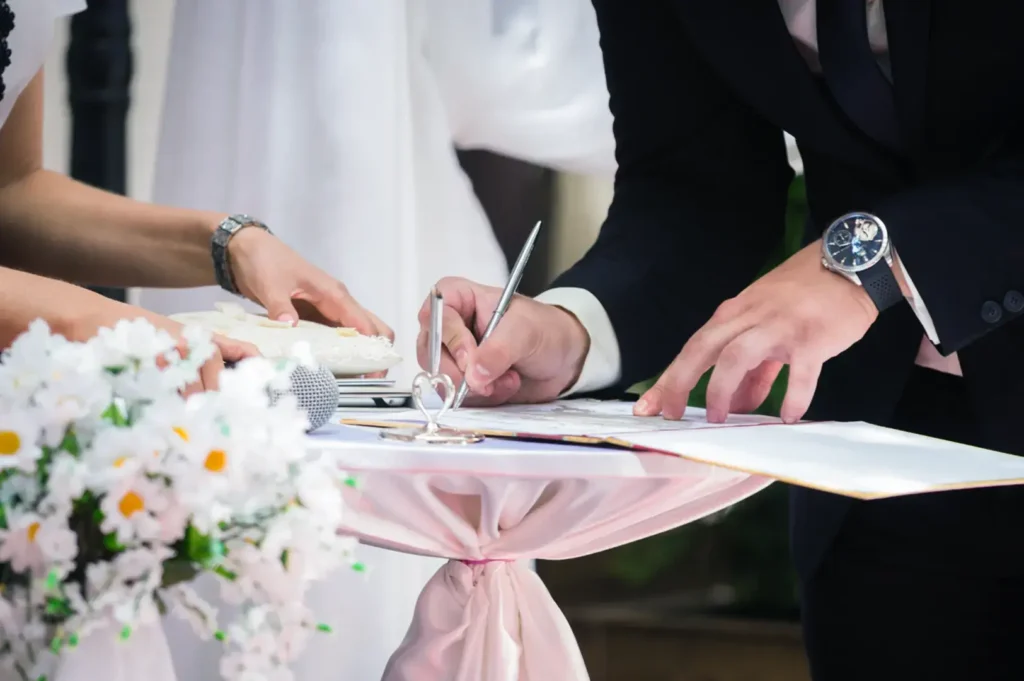
The Solemniser’s Role: A solemniser in Singapore is not just ceremonial; they are the licensed religious leaders or professionals who legally solemnise your marriage. You are legally required to have your marriage ceremony officiated by an approved licensed solemniser, in the presence of at least two credible witnesses. Their signed consent is part of the documents required for your marriage registration.
Navigating the Legal and Emotional Timeline
The state has moved almost the entire administrative marriage process to an elegant digital portal called Our Marriage Journey (OMJ), where you can file your marriage application and submit the required documents needed for your notice of marriage. But a smooth wedding day requires blending that digital efficiency with analog preparation. Expect to spend about $50 to $100 on administrative fees alone, though the actual day will cost more depending on your lunch, attire choices, and venue.
1. Determine Your Eligibility and Marriage Type
First, check the legal requirements for getting married in Singapore. Both parties must be at least 21 years old, or if one is between 18 and 21, signed consent from a legal guardian or parent is required. If either party has a previous marriage, you must provide additional documents such as divorce papers or a death certificate. At least one party must be a Singapore citizen or permanent resident, or if both are foreigners, you must show continuous residence in Singapore for at least 15 days before filing the notice of marriage.
2. Choose Your Solemnisation Style
Decide whether to have your solemnisation at the ROM office or an external venue. The ROM office offers convenience and includes a licensed solemniser, while external venues require you to engage a licensed solemniser yourself. This choice affects your guest list, the feel of your wedding ceremony, and may involve additional paperwork and fees.
3. Submit the Marriage Application
You must submit your marriage application via the OMJ portal on the ROM website at least 21 days before your solemnisation date but no earlier than six months prior. This step includes uploading original documents such as passports or NRICs for both you and your spouse-to-be, as well as for your two witnesses. Any documents in a foreign language must be accompanied by an English translated copy certified by a certified translator. The notice of marriage is a legal document that sets your wedding date and starts the clock for your marriage licence validity, which lasts three months.
Expat knowledge: The 21-Day Statutory Notice
The 21-day notice period is carved in stone. Requests to waive this notice for civil marriages will not be entertained. Filing your marriage application well in advance is strongly encouraged to secure your preferred solemniser and venue.
4. Prepare for Document Verification and Statutory Declaration
Before your solemnisation date, you and your spouse-to-be must complete document verification and a statutory declaration confirming your intent to marry. This may be done online via Singpass if eligible, or physically present at the ROM office or via a video call appointment. Bring all original documents required, including any additional documents requested during your marriage application, such as proof of divorce or existing maintenance orders if applicable.
5. Solemnise Your Marriage
On your solemnisation date, your licensed solemniser will lead the marriage ceremony, guiding you through exchanging vows and signing the marriage certificate. This legal document officially recognises you as married in Singapore. Remember, your two witnesses must be physically present in Singapore and over 21 years old.
6. Receive Your Digital Marriage Certificate
After your wedding ceremony, you will receive your digital marriage certificate, an official proof of your marriage in Singapore. This legal document can be downloaded from the ROM website and used for matters such as applying for a long-term visit pass or updating your marital status in your respective home countries.
What Not to Do When Tying the Knot
Leaving Foreign Documents to the Last Minute
If you or your spouse-to-be are from a foreign country, do not assume your home country’s documents will be accepted without question. The ROM office requires all foreign documents to be in English or Malay; otherwise, you must provide a certified English translated copy. Some documents may also need verification from your respective Singapore consulate or foreign affairs office.
Assuming the Witnesses Don't Matter
Legally, any two adults can act as your witnesses, but choosing your witnesses thoughtfully is strongly encouraged as their presence is part of the solemnisation’s emotional weight.
Forgetting the Solemniser’s Token
If you have your solemnisation outside the ROM office, it is customary to provide your solemniser with a token of appreciation, often an ang bao (red packet), to cover their time and transportation costs.
Mixing Legal and Religious Ceremonies Without Boundaries
Be clear with your families about what the ROM solemnisation represents. Setting expectations that this is the legal marriage registration and that a larger wedding ceremony will follow helps prevent misunderstandings.
Before we embrace the quiet magic of marriage in Singapore, it’s worth noting that amidst all the planning and cultural nuances, a comforting meal can be a perfect way to unwind, many couples and families find joy in sharing a hearty dish like the best Japanese curry Singapore has to offer.
Embracing the Quiet Magic of Marriage in Singapore"

Getting married in Singapore is a beautiful reflection of the city itself: deeply efficient on the surface, but running on an undercurrent of unspoken devotion, family ties, and quiet respect.
The online application is just the scaffolding. The real work is how you hold space for the cultural expectations of your families, how you honor your chosen witnesses, and how you pause to actually feel the weight of the moment before the ink dries.
Do not let the administrative checklist rob you of the poetry of the day. Print your confirmation emails, pack your original passports the night before, and inform your parents early. By handling the logistics with grace and foresight, you clear the space to simply stand in front of your partner, breathe in the humid morning air, and say yes.